

STROBE vs. RECORD: What Researchers Need to Know About Reporting Observational Studies
Observational studies form the backbone of real-world evidence in life sciences. From epidemiology to health policy, they offer critical insights where randomized controlled trials (RCTs) are impractical. However, the value of these studies depends heavily on how transparently and comprehensively they are reported.
However, given their nature, observational studies are more prone to issues like bias and third variables. To address persistent gaps in reporting quality, structured reporting guidelines such as STROBE and RECORD were developed by the to improve transparency in health research. While closely related, these frameworks serve distinct yet complementary purposes.
Why is it Important to Understand the Reporting Guidelines?
Reporting guidelines aim to standardize what authors report, ensuring that readers can clearly understand:
- What was planned
- What was done
- What was found
- What the results mean
In observational research, this need is particularly acute due to the diversity of study designs and data sources.
What Is the STROBE Statement?
The Strengthening the Reporting of Observational Studies in Epidemiology (STROBE) statement is the foundational reporting guideline for observational research.
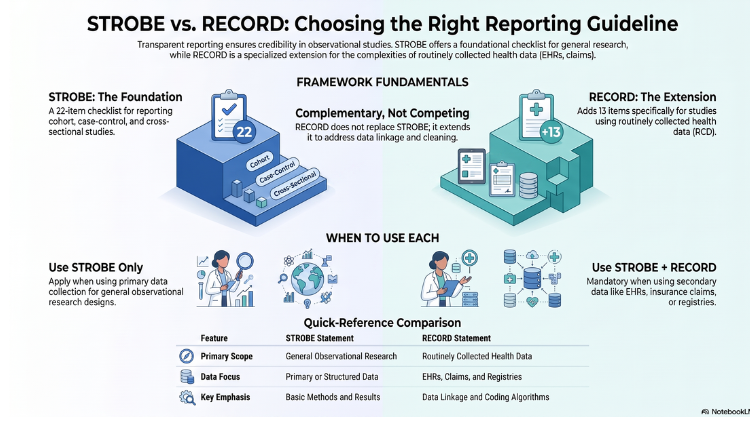
Developed by an international collaboration of researchers, epidemiologists, statisticians, and journal editors, STROBE provides a 22-item checklist covering the full structure of a research paper—from the title and abstract to methods, results, and discussion.
Key Features of STROBE
- Applies to cohort studies, case-control, and cross-sectional observational study designs
- Includes 18 general items and 4 design-specific items (Given separately for cases and controls in case-control studies and, if applicable, for exposed and unexposed groups in cohort and cross-sectional studies)
- Not intended to assess study quality or dictate methodology
- Supports transparent and standardized reporting of observational studies
Importantly, STROBE is not a protocol or design tool. It does not prescribe how researchers should conduct studies.
The Rise of Routinely Collected Data—and the Need for RECORD
With the rapid digitization of healthcare, researchers increasingly rely on routinely collected health data (RCD), such as Electronic health records (EHRs), insurance claims databases, and disease registries. Although these sources are data-rich, they are often complex as they are:
- Not originally collected for research
- Prone to coding inconsistencies
- Subject to linkage across multiple databases
STROBE alone does not fully address these unique challenges. This gap led to the development of the RECORD Statement in 2015.
What is the RECORD Statement?
The REporting of studies Conducted using Observational Routinely-collected health Data (RECORD) statement is an extension of STROBE, specifically designed for studies using routinely collected data.
Rather than replacing STROBE, RECORD extends it by adding guidance specific to routinely collected health data.
Key Features of RECORD
- Adds 13 additional reporting items tailored to RCD studies
- Emphasizes:
- Data source transparency
- Database linkage methods
- Data cleaning and validation processes
- Coding algorithms used to define populations
- Encourages detailed reporting of data provenance, processing, and limitations
For example, RECORD requires authors to specify:
- The type and name of databases used
- The geographic and temporal scope of data
- Whether data linkage was performed
STROBE vs. RECORD: Key Differences
While both frameworks aim to improve reporting transparency, their scope and focus differ significantly.
Aspect |
STROBE Statement |
RECORD Statement |
| Scope of application | Broad—applies to all observational studies (cohort, case-control, cross-sectional) | Specific—applies to studies using routinely collected health data (e.g., EHRs, claims, registries) |
| Purpose | Provides general guidance for transparent reporting of observational research | Extends STROBE to address challenges unique to routinely collected data |
| Relationship | Core reporting guideline | Extension of STROBE (not a replacement); should be used alongside STROBE |
| Target data type | Designed for general observational research across multiple data sources | Designed for routinely collected secondary health data not originally collected for research purposes |
| Data source reporting | Limited guidance | Requires detailed description of data sources, databases, and context |
| Database linkage | Not explicitly emphasized | Strong emphasis on reporting linkage methods and processes |
| Coding and algorithms | Minimal detail required | Requires explicit reporting of codes, algorithms, and definitions used |
| Data cleaning and validation | Not explicitly emphasized | Requires transparency in data cleaning, validation, and preprocessing steps |
| Level of detail | Broad and general | More granular and technically detailed |
| Use in practice | Used independently for most observational studies | Used in conjunction with STROBE for RCD-based studies |
When Should You Use STROBE vs. RECORD?
Use STROBE if:
- Your study uses an observational design
- You are using primary data collection or structured datasets
- Your study design is cohort, case-control, or cross-sectional
Use BOTH STROBE + RECORD if:
- Your study uses:
- Electronic health records
- Administrative or claims data
- Registry-based datasets
- You perform data linkage across sources
- Your data were not originally collected for research purposes
The emergence of RECORD reflects a broader shift in research culture: from simply reporting results to promoting reproducibility, transparency, and accountability. As data sources grow more complex, reporting standards must evolve accordingly. Together, STROBE and RECORD provide a robust framework to improve transparency, enhance reproducibility, and strengthen trust in observational research
They are not competing frameworks; they are complementary tools designed for different layers of observational research reporting.
For life sciences researchers, especially those working with real-world data, understanding and applying both is no longer optional but essential for producing credible, publishable, and impactful research.
Note: The feature image used in this article is generated using NotebookLM for illustration purposes only.
Author:

Anagha Nair
Editorial Assistant, Enago Academy
Medical Writer, Enago Life Sciences
Connect with Anagha on LinkedIn