
The Role of AI Chatbots in Chronic Disease Care
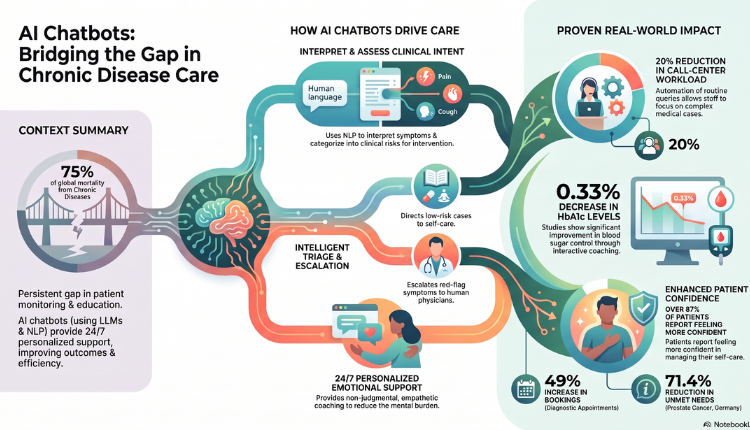
Chronic diseases such as diabetes, cardiovascular disease, chronic obstructive pulmonary disease (COPD), and chronic kidney disease account for 75 percent of total mortality worldwide. Despite advances in healthcare, a persistent care gap remains in timely intervention, continuous monitoring, and patient education. AI chatbots have emerged as a powerful tool to bridge this gap. These intelligent bots provide conversational support to patients through education, medication adherence and health monitoring. They extend the reach of care teams beyond scheduled clinic visits. [1]
What are AI Chatbots?
AI chatbots are software applications that simulate human-like conversations through text or voice. In chronic care, these conversational agents are built on large language models (LLMs) that enable personalized and adaptive interactions . By incorporating patient data, a chatbot can provide emotional support between clinical encounters and effective disease management over time. [1,2]
How Does Chatbot Work?
AI chatbots work by combining multiple machine learning algorithms to hold real-time conversations through text or voice messages. When a patient reports a symptom, the chatbot uses natural language processing (NLP) and large language models (LLM) to interpret medical terminology and common abbreviations. Then, it identifies symptoms and clinical intent to pre-defined disease categories. For example, if a user says “I have a bad [cough],” the bot understands in clinical sense as “cough” and narrows down to the possible causes through a series of follow-up questions.
Once a probable condition is identified, the system assesses its severity and determines the most appropriate next steps. For low-risk cases, it offers self-care guidance. For a red-flag symptom or high-risk presentation, it escalates immediately by connecting the patient to a physician or booking an urgent appointment. Some chatbots, during emergencies (e.g., severe chest pain), can trigger an immediate alert for human intervention. Dialog management tracks conversation history to make responses relevant and avoid repetition. [3]
Benefits of Using AI Chatbots in Chronic Disease Patient Care
Supporting Self-Management and Medication Adherence
Chatbots support patients by providing timely reminders for medication schedules, dietary plans, and fluid intake protocols. They encourage sustained lifestyle modifications, such as increased exercise and healthier eating habits, which improve patients’ quality of life. They tailor educational content and coaching based on individual’s specific conditions and preferences rather than delivering generic advice.
Psychological and Emotional Support
Chatbots are available 24/7 to support patients; by they provide non-judgemental interaction which can effectively reduce the mental burden associated with chronic illnesses. Features such as personalized goal setting and strategy selection help patients make informed health decisions, which increase their confidence in managing their disease.
Improves Operational Efficiency
Chatbots streamline clinical workflows by automating the collection of patient-reported data. It provides physicians with data for proactive interventions. By operating on commonly used social media platforms, chatbots offer low-complexity access to medical supervision, which is particularly useful for elderly patients and those from rural and underserved areas. [1,4]
Administrative and Operations Use
Chatbots can automatically check patient deductibles, copays, and prior authorization status directly with insurance system which minimize treatment delays. They provide day to day support in clinical tracking, sending medication reminders and collecting biometric data from connected health devices like glucometers and blood pressure monitors. [5]
Real World Studies of Chatbots in Chronic Patient Care
Cancer Management
- Breast Cancer (Egypt): ChemoFreeBot reduced chemotherapy side effects through personalized education. The key findings showed significantly fewer symptoms and greater improvement in self-care behaviors compared to a nurse-led group.
- Prostate Cancer (Germany) : PROState cancer Conversational Agent (PROSCA) educates patients on diagnostic tests and treatment options. Nearly, 71.4 %of patients agreed that using the bot had a greater reduction in their information needs compared to the control group.
- Head and Neck Cancer (USA): An interactive chatbot used to support patients during and after radiation therapy. Respondents (89%) found the system highly user-friendly.
Diabetes Management
- My Diabetes Coach (Australia): A Mobile App–Based Interactive Conversational Agent named Laura helped patients manage diabetes at home. At 12-month period, HbA1c was decreased by 0.33% in intervention group compared to the control group. Overall participants showed significantly greater improvements in their health-related quality of life.
- GREAT4 Diabetes (South Africa) :This bot helped educate patients, with 87.6% more confidence in their self-care.
- Social Diabetes Distress (Netherlands): An automated conversational agent delivers personalized psychoeducation on dealing with psychosocial distress to people with diabetes and reduces diabetes distress more than a self-help book.
Hypertension Management (Spain)
A chatbot assistant named TensioBot for in-house blood pressure checking showed a significant increase in patient knowledge acquisition regarding blood pressure measurement.
Parkinson’s Disease (Japan)
An AI chatbot was used to engage patients in conversation to improve smile and speech metrics, showing significant improvement in smiling and decreased use of verbal filler words
Healthcare System Efficiency – Apollo 24|7 (India)
By integrating chatbots, live chat, and automation across popular channels such as WhatsApp, this provider reduced call-center workload by 20% and increased diagnostic bookings by 49%.
Regulatory Compliance Standards
The regulatory landscape for AI healthcare chatbots is rapidly evolving, with a focus on safety, transparency, and ethical use.
Key compliance include:
FDA and Software as a Medical Device (SaMD) Regulations
In the United States, chatbots that perform diagnostic or therapeutic functions are classified as Software as Medical Devices SaMD,These devices considered medical devices unless their recommendations are subject to appropriate human oversight. This means that human monitors should be able to independently evaluate the information used to formulate suggestions provided by the software. For its part, the FDA has shifted from exploratory guidance to a set of requirements that emphasize life cycle management and transparency to bring SaMDs to market.
EU Regulations, Including the EU AI Act and Medical Device Regulation (MDR)
European frameworks classify chatbots on a risk spectrum from non-medical informational tools to high-risk devices capable of predicting serious clinical events. The EU AI Act adds further obligations around transparency, risk management, and human oversight for AI systems used in healthcare contexts.
GDPR Compliance
Any chatbot processing EU patient data must meet strict consent, data minimization, and data protection requirements. [6,7]
Challenges in Using Chatbots
Despite the potential benefits, AI chatbots face significant hurdles:
Trust and Reliability Issues
Trust remains a primary concern in adopting AI-based healthcare systems. Clinicians have raised concerns about the accuracy of AI-generated medical advice and the risk of AI generated hallucinations. This could lead to the risk of misdiagnosis or inappropriate treatment. Patients may rely on AI assessment even after clinical testing, which can complicate patient –physician relationship.
Data Security and Privacy Concerns
Chronic disease management generates continuous, sensitive health data, and patients are concerned about unauthorized access or cyber-attacks to their medical information. These information needs to be protected through robust cybersecurity measures and compliance with healthcare privacy regulations integration and technical hurdles
The effectiveness of a chatbot depends on how well it interacts with the broader healthcare ecosystem. Chatbots can handle routine queries, they often struggle with complex medical cases that require deep human expertise and comprehensive diagnostic assessments. [8]
The shift toward emotionally intelligent agents has the potential to reshape the patient-provider relationship. Rather than a replacement for clinical judgment, these agents will serve as a 24/7 empathetic companion, empowering patients through every stage of their chronic disease journey. By optimizing system functionality and privacy protection can ensure that interaction remain safe, private and medically sound. Ultimately, AI chatbots stand as a powerful, user-friendly alternative in a modern world, capable of saving lives and streamlining the global journey toward health and well-being , a promising
References
- Hou J, Lin S, Teng P, Han Y, Luo Y, He G. Application of chatbots in chronic disease management: A scoping review. Digital Health. 2026 Jan;12:20552076251411287.
- Han GI, Lee HJ, Son YJ. Natural language processing-based chatbots for chronic disease self-management: A systematic review of implementation and health outcomes. Digital health. 2026 May;12:20552076261450385.
- AI chatbots for healthcare: A guide for medical centers and healthcare providers. Available at : https://www.infobip.com/blog/healthcare-ai-chatbot-examples
- Du Y, Yang P, Liu Y, Deng C, Li X. Artificial intelligence in chronic disease self-management: current applications and future directions. Frontiers in Public Health. 2025 Nov 20;13:1689911.
- AI Chatbot Use Cases in Healthcare: 2026 Guide. Available at: https://cloudtech.com/feeds/blog/ai-chatbot-use-cases-healthcare-industry-2026
- Artificial Intelligence in Health: The Regulatory Landscape in 2026. Available at : https://healthcareaiinsights.com/regulatory-policy/artificial-intelligence-in-health-regulatory-landscape-2026
- Nehme M, Schneider F, Amruthalingam E, Schnarrenberger E, Tremeaud R, Guessous I. Chatbots in medicine: certification process and applied use case. Swiss Med Wkly. 2024;154:395
- . Wah JN. Revolutionizing e-health: the transformative role of AI-powered hybrid chatbots in healthcare solutions. Frontiers in Public Health. 2025 Feb 13;13:1530799.
Note: The feature image used in this article is generated using NotebookLM for illustration purposes only.