

Does Medical Evidence Need an Expiry Date?
Consider a disease-awareness page written in 2017 about preventing heart disease. It was medically reviewed, referenced, and approved, and told readers in their fifties with raised cardiovascular risk that daily low-dose aspirin might be worth discussing with their doctor. This matched the 2016 US Preventive Services Task Force (USPSTF) recommendation for many adults aged 50–59 with a 10-year cardiovascular risk of 10% or more.[1]
In April 2022, the USPSTF changed its recommendation. For adults aged 40–59, starting aspirin became an individual decision with a small net benefit; for adults aged 60 and over, it recommended against starting aspirin due to bleeding risk. Aspirin was linked to a 58% increase in major gastrointestinal bleeding and a 31% increase in intracranial bleeding.[1]
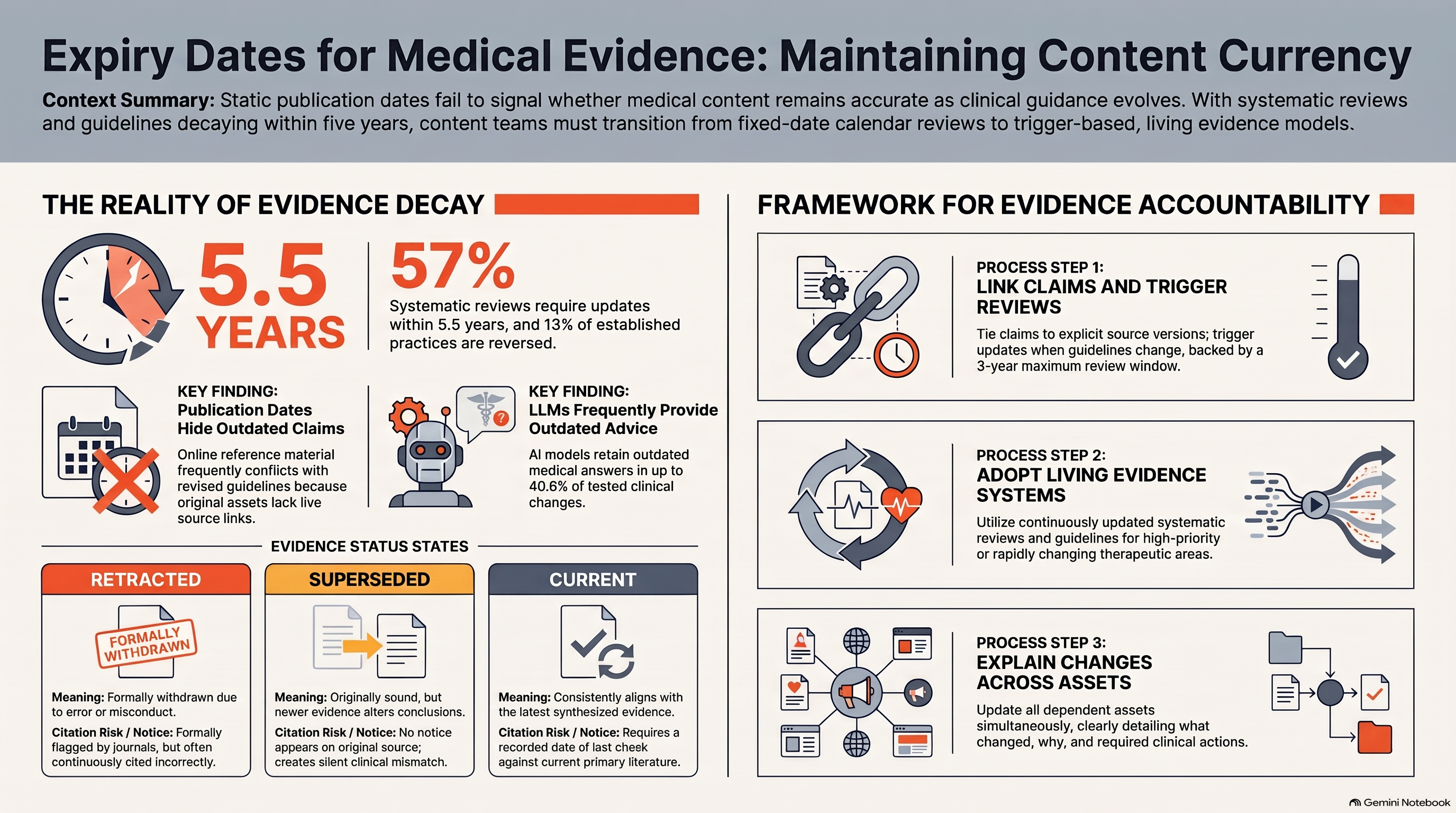
The page was accurate when published but is now superseded with new information. . Its date shows when it was written, not whether it has been checked . Should medical content state not only what is known, but also when that knowledge was last checked, and against which source?
How Quickly Evidence Changes
The volume of evidence is growing rapidly. More than 30,000 articles containing the word “stroke” were indexed in PubMed in 2020, 2.3 times as many as in 2010 and 5 times as many as in 2000.[2] No individual can keep up with all the available information.[3]
Even the most rigorous evidence also have a measurable shelf life. Of 100 high-quality systematic reviews, 57% showed a signal for updating. The median time to a signal was 5.5 years, but 23% were signalled within two years and 7% already at publication; cardiovascular topics expired faster.[4] Of 17 US clinical practice guidelines, about half were outdated within 5.8 years, and the authors recommended reassessing guidelines every three years.[5] A review of more than 3,000 randomised trials in JAMA, The Lancet, and NEJM identified 396 established practices found to be no better than a prior or lesser standard of care[6]
Retracted, Superseded or Current
Outdated evidence tis not fraudulent but sound research with novel studies have overtaken. A cited source can be in one of three states, and only retraction is formally flagged by journals.
| Status | What it means | Example |
| Retracted | Found unreliable, for example because of error or misconduct, and formally withdrawn. Should no longer be cited as valid. | An omega-3 trial in COPD, retracted in 2008 for falsified data, kept being cited; 96% of 112 post-retraction citations examined did not mention the retraction.[7] |
| Superseded | Sound for its time, but later evidence has changed the conclusion. No notice appears on the original. | A page recommending aspirin for primary prevention in adults aged 60 and over, after the 2022 USPSTF update.[1] |
| Current | Valid with the best available evidence, but needs a recorded date of last check. | A page recommending corticosteroids for severe COVID-19, retained across successive WHO guideline updates. |
A publication date cannot tell readers which state applies, even in professional resources. Jeffery and colleagues examined 200 treatment topics in four continuously updated online textbooks (DynaMed, UpToDate, PIER and Best Practice). The proportion of topics where newer trials or systematic reviews differed from the textbook’s recommendation ranged from 23% to 60%.[8] In a 2018 study comparing 89 German-language web pages on prostate cancer with European Association of Urology guidelines, agreement ranged from 63% for screening to 36% for therapy and 8% for complications.[9]
Challenges in Keeping the Evidence Live
Multiple dependent assets Information can reach via a website, a patient leaflet, a healthcare professional slide deck, an education module and social media posts, each with its own owner, approval route and review date. A change in the evidence does not automatically reach all of them.
Fixed review dates. Scheduled reviews can prompt premature updates in slow-moving fields and miss changes in fast-moving ones. Updating may be needed when evidence on benefits and harms, important outcomes, values, or resources changes.[10]
Communicating the change. People already taking aspirin were advised not to stop without talking to their clinician.[1] A page rewritten only to say “aspirin is not recommended” could prompt a wrong action. Updates should state what changed, why, and what readers should and should not do. They should also make clear whether the change affects clinical advice or is only an editorial correction.
Existing Review Mechanisms
- Promotional material: The Association of the British Pharmaceutical Industry (ABPI) Code of Practice requires material still in use to be recertified at least every two years, to ensure that it continues to comply with the Code.[11]
- Guidelines: NICE surveillance is triggered by events such as a relevant new study, a drug withdrawal or a safety update, with safety issues prioritised.[12]
- Patient information: The PIF TICK, the UK quality mark awarded by the Patient Information Forum (PIF), requires up-to-date evidence and a process for timely review.[13]
- Quality criteria: Since 1997, benchmarks for online health information have listed currency as a core standard.[14]
Mitigation: Living Evidence and Active Review
Living systematic reviews are continually updated, with new evidence incorporated as soon as it becomes available.[15,16] Cochrane suggests them for high-priority questions where certainty is low and likely to encounter new research.[16]
Living guidelines use continuous surveillance and rapid updating because five-year update cycles are too slow for some recommendations.[17] The WHO living guideline on drugs for COVID-19, informed by a living systematic review and network meta-analysis, was reissued as trials reported that added strong recommendations against hydroxychloroquine and lopinavir-ritonavir.[18] The Australian Living Stroke Guidelines use monthly surveillance, and 86% of expert assessments supported continuing this approach.[19]
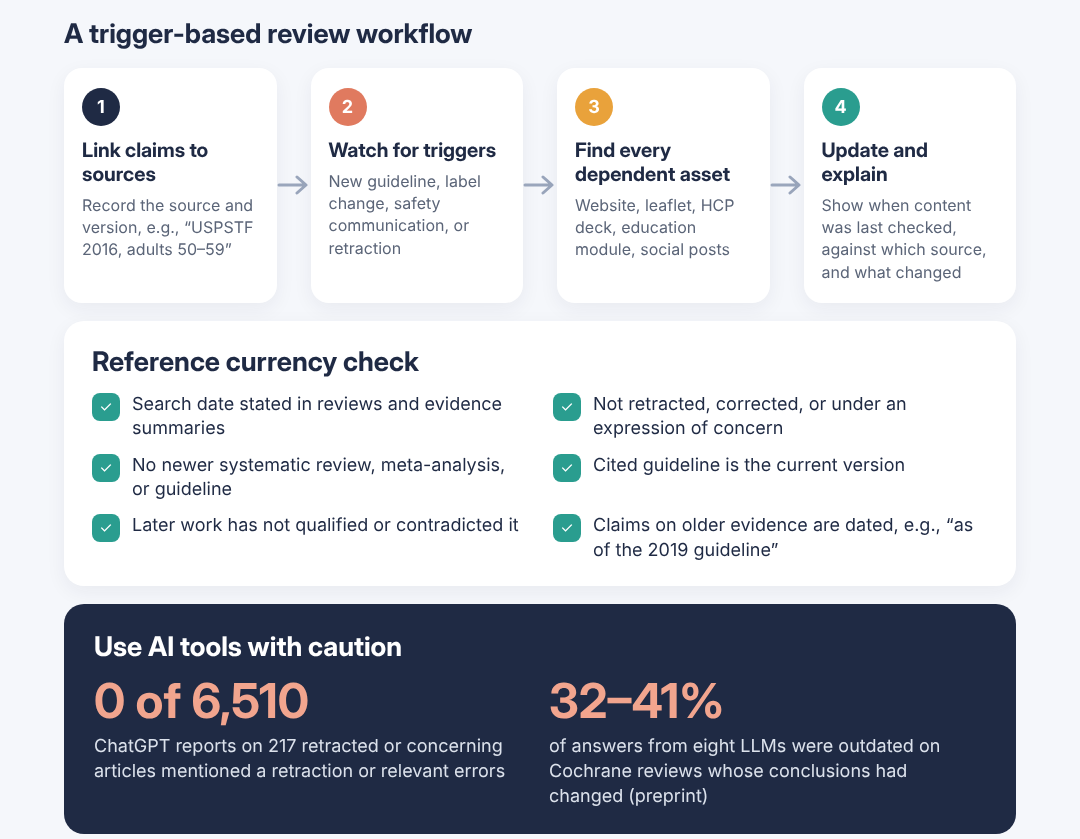
Journal and PubMed alerts, society newsletters, journal clubs and manuscript review help reviewers keep up with the literature.[2] When reviewing a manuscript, reviewers should check that each key reference is still current: not retracted or corrected, not superseded by a newer review or guideline, and dated where it rests on older evidence.
Using AI Tools with Caution
Large language models (LLMs) are trained on data up to a fixed cut-off and may not reflect later retractions, guideline updates or trials. When ChatGPT evaluated 217 retracted or otherwise concerning articles 30 times each, none of the 6,510 reports mentioned a retraction or relevant errors.[20] In a 2025 preprint, eight LLMs answering 512 questions on Cochrane reviews whose conclusions had changed gave the outdated answer 32.0% to 40.6% of the time.[21] AI-generated summaries should be treated as a starting point, with every source verified against current primary literature.
Takeaways for Medical Communicators
- Link claims to sources. Record the source and version behind each key clinical claim when content is created.
- Review on triggers, not only on dates. Start review when a guideline, label, safety communication or retraction affects a source, prioritised by clinical risk, with a calendar backstop of about three years.[5]
- Draw on living evidence. Use living systematic reviews and guidelines as sources where they exist.[16–19]
- Build currency checks into review. Make the reference checks above part of medical, regulatory and peer review sign-off.
- Update and explain together. Update all dependent assets, including translations, and show readers when content was last checked and what changed.
- Verify AI-assisted outputs. Check the status and currency of every source in an AI-generated summary.[20,21]
Older evidence does not need to be discarded, but its status should be stated clearly. Every source, whether used by a person or an AI tool, should meet two tests: is it still reliable, and is it still the best available evidence? Trust in medical information depends on a verifiable process for keeping it accurate as the evidence changes.
References
- US Preventive Services Task Force. Aspirin use to prevent cardiovascular disease: recommendation statement. April 2022 (replacing the 2016 recommendation). Summarised in: USPSTF updates recommendation on aspirin to prevent CVD. AAFP News, 9 May 2022. https://www.aafp.org/news/health-of-the-public/uspstf-aspirin-cvd.html
- Kamtchum-Tatuene J, Zafack JG. Keeping up with the medical literature: why, how, and when? Stroke. 2021;52:e746–e748. doi:10.1161/STROKEAHA.121.036141
- Wolters Kluwer. Keeping up with medical knowledge: how to stay on top of medical advances. Expert Insights. Updated 26 August 2020. https://www.wolterskluwer.com/en/expert-insights/keeping-up-with-medical-knowledge-how-to-stay-on-top-of-medical-advances
- Shojania KG, Sampson M, Ansari MT, Ji J, Doucette S, Moher D. How quickly do systematic reviews go out of date? A survival analysis. Ann Intern Med. 2007;147(4):224–233. PMID: 17638714
- Shekelle PG, Ortiz E, Rhodes S, Morton SC, Eccles MP, Grimshaw JM, Woolf SH. Validity of the Agency for Healthcare Research and Quality clinical practice guidelines: how quickly do guidelines become outdated? JAMA. 2001;286(12):1461–1467. doi:10.1001/jama.286.12.1461
- Herrera-Perez D, Haslam A, Crain T, Gill J, Livingston C, Kaestner V, et al. A comprehensive review of randomized clinical trials in three medical journals reveals 396 medical reversals. eLife. 2019;8:e45183. doi:10.7554/eLife.45183
- Schneider J, Ye D, Hill AM, Whitehorn AS. Continued post-retraction citation of a fraudulent clinical trial report, 11 years after it was retracted for falsifying data. Scientometrics. 2020;125(3):2877–2913. doi:10.1007/s11192-020-03631-1
- Jeffery R, Navarro T, Lokker C, Haynes RB, Wilczynski NL, Farjou G. How current are leading evidence-based medical textbooks? An analytic survey of four online textbooks. J Med Internet Res. 2012;14(6):e175. doi:10.2196/jmir.2105
- Bruendl J, Rothbauer C, Ludwig B, et al. Accordance of online health information on prostate cancer with the European Association of Urology guidelines. Urol Int. 2018. https://urotoday.com/recent-abstracts/urologic-oncology/prostate-cancer/102540-accordance-of-online-health-information-on-prostate-cancer-with-the-european-association-of-urology-guidelines.html
- Shekelle P, Eccles MP, Grimshaw JM, Woolf SH. When should clinical guidelines be updated? BMJ. 2001;323(7305):155–157. doi:10.1136/bmj.323.7305.155
- Prescription Medicines Code of Practice Authority. ABPI Code of Practice for the Pharmaceutical Industry 2024, Clause 8.5. https://pmcpa.org.uk/media/r0anf5ya/2024-abpi-code.pdf
- Developing NICE guidelines: the manual (PMG20), Chapter 13: Ensuring that published guidelines are current and accurate. https://www.nice.org.uk/process/pmg20/chapter/ensuring-that-published-guidelines-are-current-and-accurate
- Patient Information Forum. About the PIF TICK; and PIF TICK webinar: How and when to review your information resources. https://pifonline.org.uk/pif-tick/about-pif-tick/
- Silberg WM, Lundberg GD, Musacchio RA. Assessing, controlling, and assuring the quality of medical information on the Internet: Caveant lector et viewor—Let the reader and viewer beware. JAMA. 1997;277(15):1244–1245.
- Elliott JH, Turner T, Clavisi O, Thomas J, Higgins JPT, Mavergames C, Gruen RL. Living systematic reviews: an emerging opportunity to narrow the evidence-practice gap. PLoS Med. 2014;11(2):e1001603. doi:10.1371/journal.pmed.1001603
- Thomas J, Askie LM, Berlin JA, Elliott JH, Ghersi D, Simmonds M, Takwoingi Y, Tierney JF, Higgins JPT. Chapter 22: Prospective approaches to accumulating evidence. In: Higgins JPT, et al., eds. Cochrane Handbook for Systematic Reviews of Interventions. Version 6.5. Cochrane; 2024. https://www.cochrane.org/authors/handbooks-and-manuals/handbook/current/chapter-22
- World Health Organization. Keeping global recommendations up to date: a living guidelines approach to maternal and perinatal health. 19 August 2019. https://www.who.int/news/item/19-08-2019-keeping-global-recommendations-up-to-date-a-living-guidelines-approach-to-maternal-and-perinatal-health
- Lamontagne F, Agoritsas T, Siemieniuk R, et al. A living WHO guideline on drugs for covid-19. BMJ. 2020;370:m3379. doi:10.1136/bmj.m3379
- Turner T, McDonald S, Wiles L, et al. How frequently should “living” guidelines be updated? Insights from the Australian Living Stroke Guidelines. Health Res Policy Syst. 2022;20(1):73. doi:10.1186/s12961-022-00866-7
- Thelwall M, Katsirea I, Lehtisaari M, Holmberg K. Does ChatGPT ignore article retractions and other reliability concerns? Learned Publishing. 2025. doi:10.1002/leap.2018
- Vladika J, Dhaini M, Matthes F. Facts fade fast: evaluating memorization of outdated medical knowledge in large language models. arXiv preprint. 2025. arXiv:2509.04304
Author:

Rebecca D’souza, PhD.
Associate Content Expert, Enago Academy
Connect with Rebecca on LinkedIn