

Good AI Practice in Drug Development: A New Framework
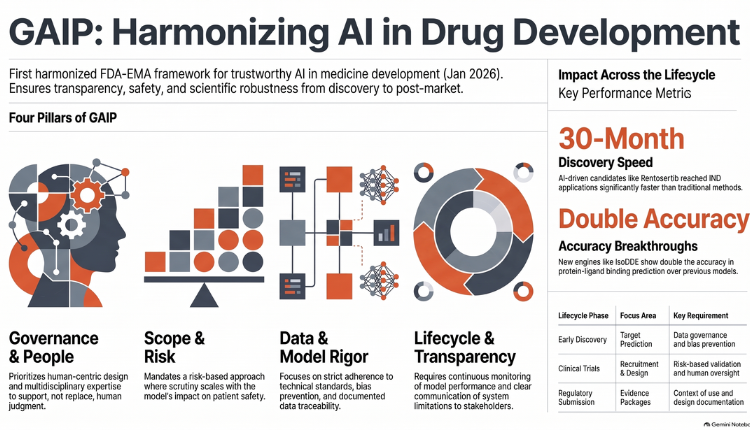
Artificial intelligence is changing how medicines are discovered, developed and monitored. AI now supports every stage of drug development process right from identifying new drug targets to monitoring safety after approval. As adoption has increased, many companies have started using different methods to validate AI models, creating uncertainty for products marketed in both U.S. and European markets.(1)
Recognizing this shift, the U.S Food and Drug Administration (FDA) and the European Medicines Agency (EMA) jointly released the Guiding Principles of Good AI Practice (GAIP) in Drug Development in January 2026 – first harmonized framework between the two largest drug regulatory agencies in the world. Their joint guiding framework encourage trustworthy, transparent and scientifically robust use of AI thought the drug development lifecycle.
What is the Good AI Practice Framework
Good AI practice is a principle-based framework. It gives a common foundation that organizations can apply across different AI technologies and stages of drug development. This framework addresses key areas of AI research such as data governance, model lifecycle management and transparency.
The framework lists ten principles covering the full drug development lifecycle, from early discovery through post-market safety monitoring. They fall into four themes, which makes the framework easier to understand and apply.
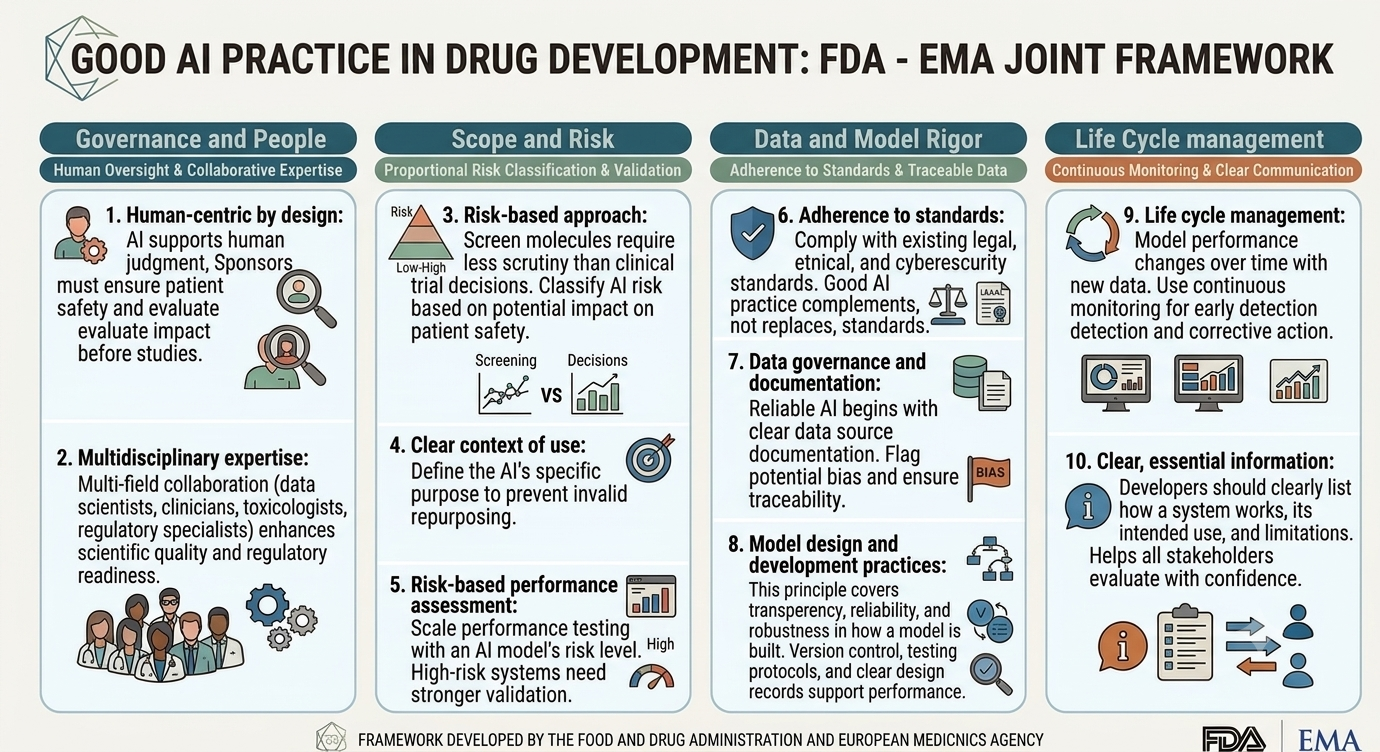
Governance and People
- Human-centric by design: AI should support human judgment rather than replacing it. Sponsors need to evaluate how an AI system affects patients and consider safety measures before the start of a study.
- Multidisciplinary expertise: Building a trustworthy AI requires collaboration among data scientists, clinicians, toxicologists, and regulatory specialists. This improves scientific quality and regulatory readiness.
Scope and Risk
- Risk-based approach: Every AI model does not carry the same level of risk. A model that screen molecules in early discovery needs less scrutiny than one that supports clinical trial decisions. This approach calls for risk classification of AI tools based on their potential impact on patient safety, product quality, and regulatory decisions.
- Clear context of use: Every AI application serves a defined purpose. The intended use of the model should be clearly specified to prevent repurposing in other conditions where it was never validated.
- Risk-based performance assessment: Performance testing should scale with an AI model’s risk level. A High risk system requires stronger testing before supporting regulatory decisions.
Data and Model Rigor
- Adherence to standards: AI systems should meet existing legal, ethical, technical, and cybersecurity standards. Good AI practice does not replace those standards, it complements them.
- Data governance and documentation: A model’s reliability begins with the data behind it. Sponsors should clearly document data sources and flag potential sources of bias to improve traceability throughout the model lifecycle.
- Model design and development practices: This principle covers transparency, reliability, and robustness in how a model is built. Version control, testing protocols, and a clear design records support consistent model performance and regulatory review.
Life Cycle management and Transparency
- Life cycle management: An AI model performance changes over time as new data becomes available. Continuous monitoring helps to identify performance changes early and supports timely corrective action.
- Clear, essential information: AI system developers should clearly list how a system works, its intended use and limitations. This helps regulators, clinicians and other stakeholders evaluate AI system with greater confidence.(2)
How it Fits Within Existing Regulations
The EMA–FDA principles are built on existing regulatory pattern that reinforces: trustworthy technology depends on trustworthy execution. The new framework places greater attention on AI specific issues such as model governance, transparency, lifecycle management and ongoing oversight.
In EMA, the EU AI Act is making governance expectations increasingly concrete. Rules on prohibited practices and AI literacy took effect on 2 February 2025. The EU AI Act’s Transparency Rules become fully applicable on 2 August 2026.
In the US, FDA’s October 2024 guidance on electronic systems, electronic records and electronic signatures in clinical investigations clarifies what makes electronic records and systems trustworthy and reliable. It is not a AI specific guidance but it becomes directly relevant when AI output is part of evidence generation. If AI influences evidence, decisions and the integrity of the electronic record that produced it–matters more, not less.
None of this suggests regulators want to slow innovation. The joint principles are meant to encourage responsible use. The operational bar is rising in a way that rewards organizations that make oversight practical, repeatable and scalable.(3)
How the Principles Apply Across the Drug Development lifecycle:
| Lifecycle Phase Early Discovery | Common AI Application | Where the Principles Matter Most |
| Early Discovery | Molecular design and target prediction | Data governance and bias prevention |
| Preclinical and Safety | Toxicity and ADME prediction | Model transparency and reduced animal testing |
| Clinical Trials | Patient recruitment and trial design support | Risk-based validation and human oversight |
| Manufacturing and Pharmacovigilance | Process optimization and safety signal detection | Life cycle monitoring and documentation |
| Regulatory Submission | Dossier compilation and submission ready evidence packages. | Context of use, human oversight and documentation. |
Real World Studies on Use of AI in Drug Development
- Insilico Medicine (China): Rentosertib, one of the most transparently documented AI-discovered and AI-designed drug candidates to date. The company used PandaOmics for target identification and Chemistry42 to design a small-molecule inhibitor for idiopathic pulmonary fibrosis (IPF). The program progressed from preclinical studies to an Investigational New Drug (IND) application in about 30 months, notably faster than the traditional drug discovery stage. Early clinical trial results showed a favorable safety profile and improvement in lung function. Phase III has started in July 2026 and regulatory submission targeted for 2030.
- Isomorphic Labs (UK): Isomorphic Labs applies the AlphaFold3 protein structure prediction model to drug discovery. This approach extends protein structure prediction into therapeutic design and supports researchers during the early stages of drug development. In Feb 2026 , the company released Isomorphic Labs Drug Design Engine (IsoDDE), which delivers more than double AlphaFold 3 accuracy on the protein-ligand binding structure and antigen – antibody prediction
- Recursion Pharmaceuticals and Exscientia (USA): These two AI-native biotech companies merged in 2024, combining large-scale phenomics with AI-driven molecular design. By early 2027, the combined company reported roughly $450 million in upfront and milestone payments from pharmaceutical partnerships, with five differentiated clinical programs advancing.
Challenges in the Use of AI in Drug Development
![Challenges in Use of AI in Drug Development]()
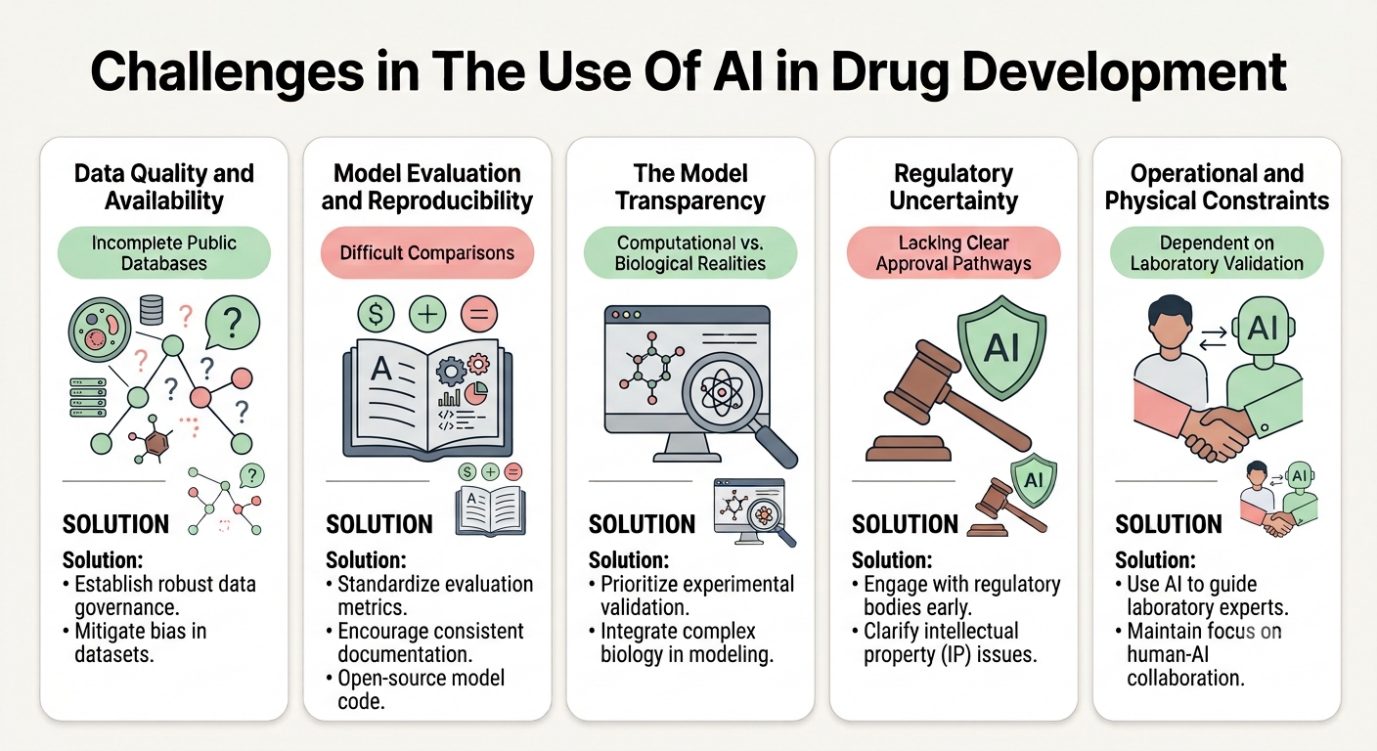
Data Quality and Availability
AI performance depends on quality and relevance of training data. Poor data quality restricts model performance and reduces confidence in results. Drug development datasets and records of failed compounds often kept within individual pharmaceutical companies .so, public database contains more information on successful compounds than failed one. Biological and biomedical data are also heterogeneous, biased towards particular population which makes data integration difficult and affects model performance. Organizations should establish strong governance practices before the development of AI models.
Model Evaluation and Reproducibility
Different research groups often use different datasets, evaluation methods and performance measures. Direct comparison between AI models becomes difficult. Proprietary software, closed-source algorithms and differences in deep learning training further limit reproducibility. Consistent documentation, standardized testing and transparent reporting can improve clinical and regulatory confidence.
Model Transparency
AI Models can predict computational surrogates, such as binding affinity, yet fails while translating into complex biological realities of a human body. A generative model can design entirely new molecules, but they may face significant feasibility challenges when scientists attempts to create them in a lab. This lacks transparency in producing accurate predictions. Therefore experimental validation remains an essential step in drug development.
Regulatory Uncertainty
AI development has outpaced current legal and oversight frameworks. The new framework improves alignment between regulators but still there is a lack of clear approval pathways for AI-generated molecules and uncertainty remain about how to handle intellectual property for drugs designed by an algorithm.
Operational and Physical Constraints
Even the most advanced AI still depends on laboratory experiments, manufacturing processes and expert scientific review to confirm their drug development predictions. AI is currently viewed as a lab partner rather than a replacement for human experts. It needs human guidance for critical decisions and experimental validation.(4)
The FDA – EMA Good AI Practice framework provides a common language for trustworthy AI in drug development. Clinical research stakeholders should define each model’s intended use, risk, performance and control changes throughout the lifecycle. As AI adoption grows along pharmaceutical research, success depends on maintaining scientific rigor and human oversight over every stages of drug development.
References
- Oualikene-Gonin W, Jaulent M-C, Thierry J-P, Oliveira-Martins S, Belgodère L, Maison P, et al. Artificial intelligence integration in the drug lifecycle and in regulatory science: policy implications, challenges and opportunities. Front Pharmacol. 2024;15:1437167. doi:10.3389/fphar.2024.1437167
- European Medicines Agency (EMA). EMA and FDA set common principles for AI in medicine development [News release]. 2026 Jan 14. [cited 2026 Jan 28]. Available from: https://www.ema.europa.eu/en/news/ema-fda-set-common-principles-ai-medicine-development-0
- Allard C, Pallavi P. What’s changing in AI regulation for drug development. Eur Pharm Rev.2026. Available from: https://www.europeanpharmaceuticalreview.com/whats-changing-in-ai-regulation-for-drug-development/2135546.article
- Seyhan AA, Carini C. Artificial Intelligence in drug discovery and development: current landscape, challenges, and future perspectives. Crit Rev Oncol Hematol. 2026;226(105461):105461. doi:10.1016/j.critrevonc.2026.105461
Note: The images used in this article are generated using Gemini Notebook for illustration purposes only.