

What Transparency Should Look Like in Patient-Facing Clinical Research Document
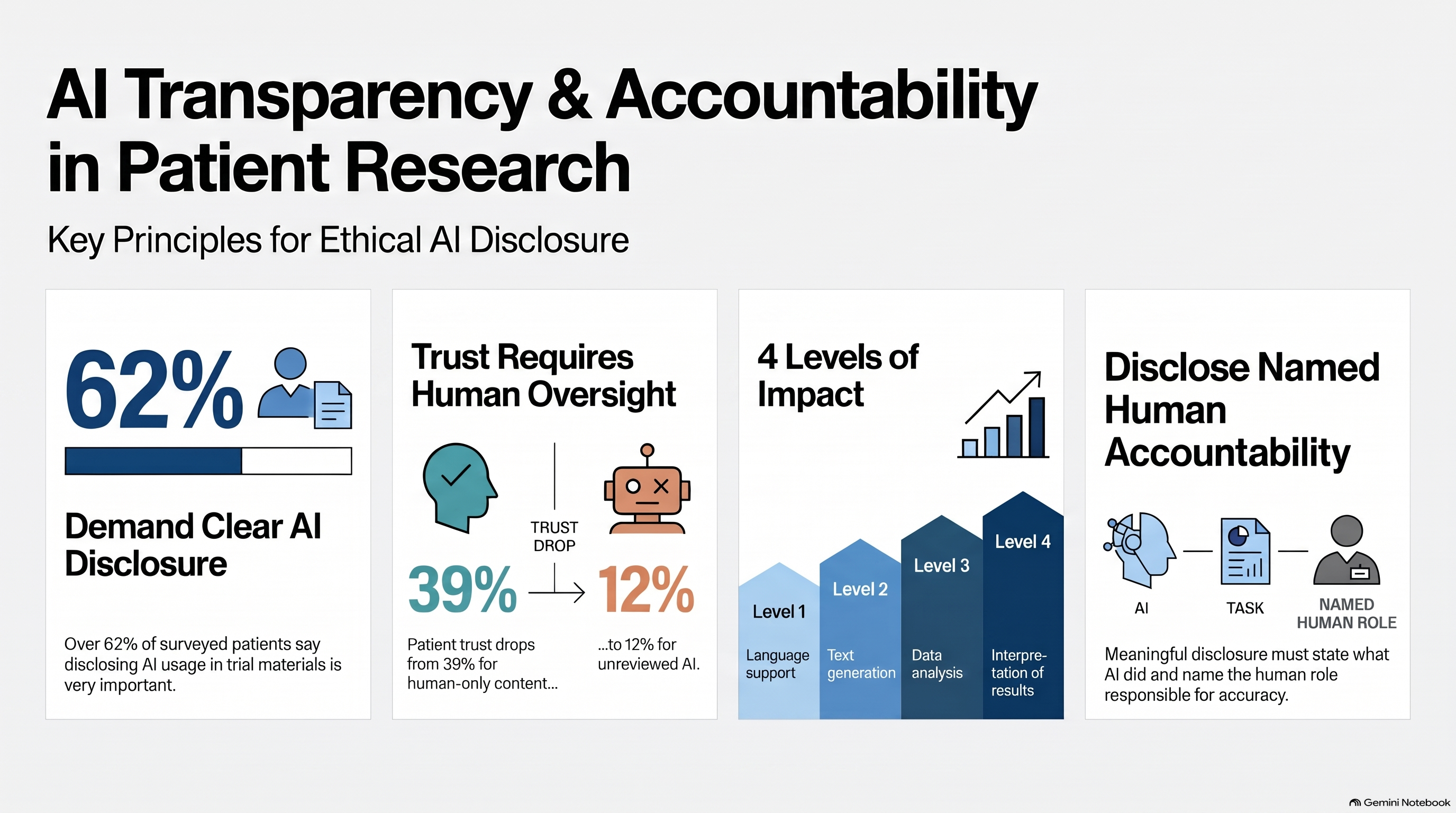
A trial participant sits down with an informed consent form, or opens a summary of the trial’s results. Parts of that document may have been drafted, simplified or translated with the help of AI. Should they be told? And if they are, would it actually help them?
Whether AI was used matters less than how much it shaped what the document means. And a disclosure only carries weight when a named person stands behind the content.
What Participants say They Want
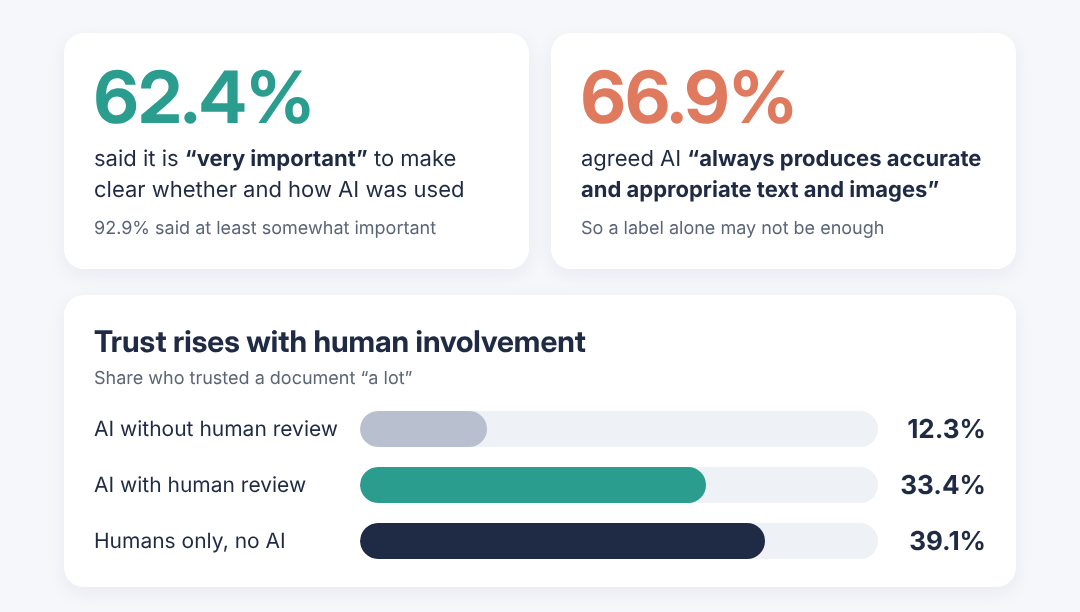
One of the few studies to ask patients directly is a 2026 survey study in JMIR AI led by CISCRP. It surveyed 1,010 adults with medical conditions in the US and Europe in March 2024. As a cross-sectional perception survey, it captures what people say they want rather than how disclosure works in practice. Still, the respondents were clear:
- 4% said it was “very important” for pharmaceutical companies and academic institutions to make clear whether and how they used AI in patient-facing documents. 92.9% said it was at least somewhat important.
- 0% rated it “very important” and 95.0% at least somewhat important.
Trust also rose with human involvement. These are the shares who trusted a document “a lot”:
| Who produced the document | Trust “a lot” |
| AI without human review | 12.3% |
| AI with human review | 33.4% |
| Humans only, no AI | 39.1% |
Then comes the twist. Two-thirds of respondents (66.9%) agreed that AI “always produces accurate and appropriate text and images.” The survey did not test how readers respond to disclosure labels. In our view, though, this finding suggests that some readers may place more confidence in AI than the technology currently warrants. If so, a disclosure label alone could reassure them when it shouldn’t. Disclosure has to come with accountability.
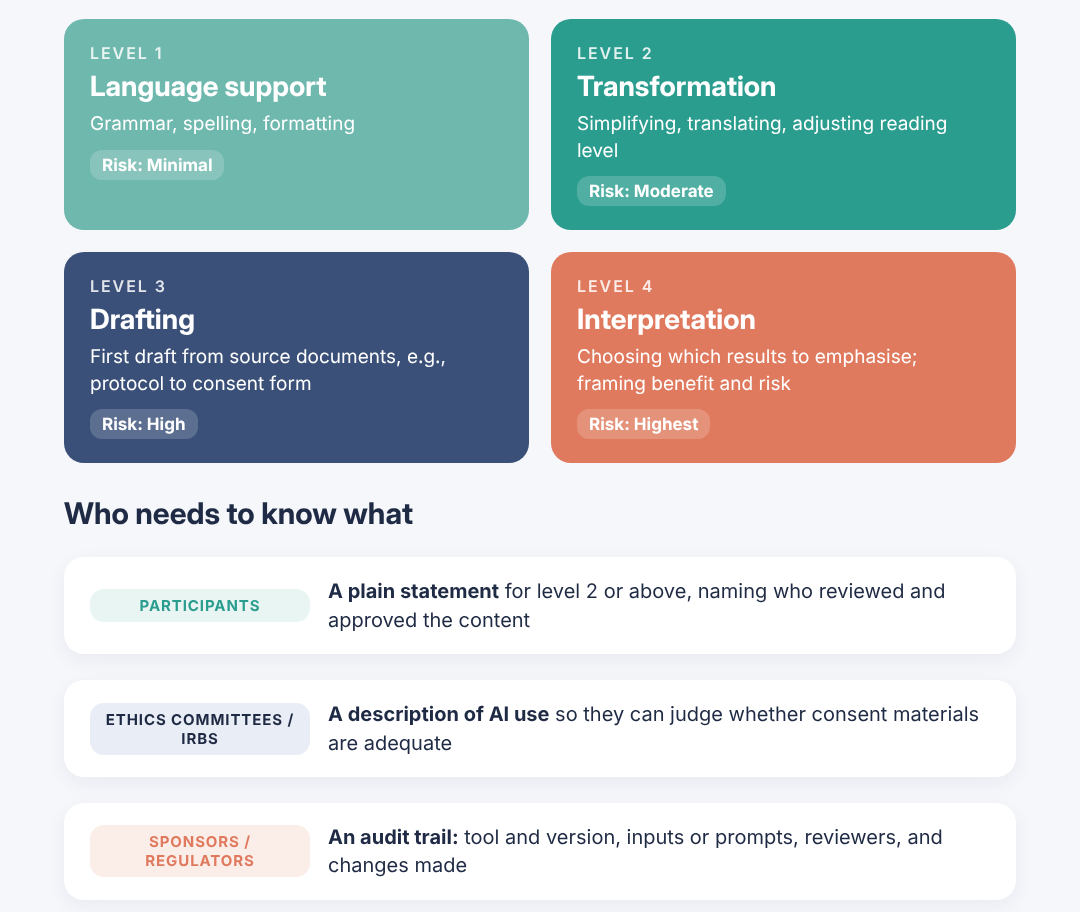
The survey did not ask whether disclosure should vary by the task AI performed. Not all AI use is the same. For practical purposes, we propose sorting AI use in patient-facing documents into four levels by asking one question: could the AI have changed what the document means? This is our working framework, not a recognized classification system.
| Level | What AI does | Risk to meaning |
| 1. Language support | Grammar, spelling, formatting | Minimal |
| 2. Transformation | Simplifying, translating, adjusting reading level | Moderate: wording on risk and uncertainty can drift |
| 3. Drafting | Producing a first draft from source documents, such as a protocol turned into a consent form | High: a human must verify it against the source |
| 4. Interpretation | Choosing which results to emphasise, or how to frame benefit and risk | Highest: a judgement call, not a writing task |
Level 2 deserves the closest look. Simplification seems harmless, yet it may be where a consent form is most exposed. When text gets shorter and plainer, nuance about risk and uncertainty can be lost, so simplified passages need careful checking against the source.
Proportionate Disclosure
- Participants should, in our view, receive a plain statement in the document whenever AI was used at level 2 or above. No current guidance sets this threshold; it is our suggested practice. It should name who reviewed and approved the content.
- Ethics committees and IRBs need a description of how AI was used, so they can judge whether the consent materials are adequate.
- Sponsors and regulators need an internal audit trail: the tool and its version, the inputs or prompts, the reviewers, and the changes made.
Level 1 use needs only an internal record. Level 4 is different. Interpreting results for patients is a judgement call, so it should stay with a qualified expert. If AI plays any part in it, that part should be disclosed and explained.
The EU AI Act, Article 50(4), applies from 2 August 2026. It requires deployers of AI systems that generate or manipulate text published to inform the public on matters of public interest to disclose that the text was AI-generated or manipulated. There is an exception, though. The duty does not apply where the content “has undergone a process of human review or editorial control” and a natural or legal person “holds editorial responsibility for the publication of the content.” Both conditions must be met, and how regulators will interpret them in practice is still being clarified.
That raises the sharpest question here. If human sign-off removes the legal duty, is the legal minimum the right ethical standard for patients? Whether Article 50(4) covers consent forms or lay summaries at all is unsettled, and sponsors should take legal advice on it.
Journals are further ahead. The ICMJE recommendations require authors to disclose whether and how they used AI-assisted technologies. They also make accountability explicit: AI tools cannot be listed as authors because they cannot take responsibility for the work, and the humans who use them remain responsible for its accuracy and integrity. Patient-facing trial documents have no equivalent norm, yet the same principle could guide them. Under the EU Clinical Trials Regulation, sponsors must provide trial results in a format understandable to laypersons. More mandatory documents mean more temptation to automate them.
What Good Disclosure Looks Like
A useful disclosure passes three tests. It is specific about what AI did, it names who is accountable, and a participant can understand it. Compare these two:
- Vague: “AI tools may have been used in preparing this document.”
- Good: “This summary was drafted with the help of an AI tool. It was checked against the study results and approved by [role] at [organisation], who are responsible for its accuracy.”
The first tells the reader nothing they can act on. The second tells them what happened and who answers for it.
What could go wrong
- Boilerplate fatigue: The same statement on every document soon stops being read.
- Rubber-stamp review: “Human-reviewed” means nothing if the review is cursory.
- Unnecessary worry: Disclosure can unsettle readers even when AI only fixed the grammar.
Each of these is an argument for proportionate disclosure rather than a blanket rule.
Conclusion
Patients don’t need a list of every tool that touched a document.
They need to know who is accountable for ensuring the accuracy of the information they receive, regardless of whether AI assisted in producing it.
As AI becomes increasingly integrated into clinical research communications, transparency alone will not be enough; meaningful human accountability will remain essential for maintaining participant trust
References
- CISCRP Staff. “Patient Perceptions on the Use of AI in Creating Clinical Research Documents: Survey Study.” CISCRP, June 25, 2026. https://www.ciscrp.org/patient-perceptions-on-the-use-of-ai-in-creating-clinical-research-documents-survey-study.
- Delev, Zlatko. “EU AI Act Article 50: Transparency Rules for Businesses.” GDPR Local, July 15, 2026. Updated October 15, 2026. https://gdprlocal.com/eu-ai-act-article-50/.
- Edwards, Kimbra, Samuel Entwisle, Zack Fey, Hana Do, Art Gertel, Annick de Bruin, and Kenneth Getz. “Patient Perceptions on the Use of Artificial Intelligence in Creating Clinical Research Documents: Survey Study.” JMIR AI 5 (2026): e76547. https://doi.org/10.2196/76547.
- EU Artificial Intelligence Act. “Article 50: Transparency Obligations for Providers and Deployers of Certain AI Systems.” Accessed October 26, 2026. https://artificialintelligenceact.eu/article/50/.
- European Commission. Summaries of Clinical Trial Results for Laypersons: Recommendations of the Expert Group on Clinical Trials for the Implementation of Regulation (EU) No 536/2014 on Clinical Trials on Medicinal Products for Human Use. Version 2. Brussels: European Commission, 2018. https://health.ec.europa.eu/document/download/0559976c-ce71-4894-bbc2-cca922acb5ad_en?filename=2017_01_26_summaries_of_ct_results_for_laypersons.pdf.
- International Committee of Medical Journal Editors. “Use of AI by Authors.” In Recommendations for the Conduct, Reporting, Editing, and Publication of Scholarly Work in Medical Journals. Updated January 2026. https://www.icmje.org/recommendations/browse/artificial-intelligence/ai-use-by-authors.html.
Author:

Rebecca D’souza, PhD.
Associate Content Expert, Enago Academy
Connect with Rebecca on LinkedIn