

ICMJE 2026 Revised Recommendations: Key changes and implications for medical communication and publishing

The International Committee of Medical Journal Editors (ICMJE) periodically updates its Recommendations for the Conduct, Reporting, Editing, and Publication of Scholarly Work in Medical Journals to address emerging ethical, technological, and methodological realities. The latest January 2026 update introduces important updates that strengthen transparency, clarify author responsibilities, and establish formal guidance on the use of artificial intelligence in research and publishing workflows.
These changes reflect growing recognition of new integrity risks, particularly those related to AI-assisted manuscript preparation, sponsor influence on data access, and the need for clearer accountability in scientific reporting.
Why This Update Matters Now?
The 2026 revision comes at a pivotal moment for the research ecosystem. The rapid integration of generative AI into research and writing workflows, increasing scrutiny of sponsor influence over data access and analysis, and heightened attention to research integrity have exposed governance gaps in existing policies.
The updated recommendations address these challenges by strengthening disclosure requirements, formalizing expectations for responsible AI use, and reinforcing the principle that authors must have independent access to and responsibility for the underlying study data.
ICMJE January 2026 Updates
1. Financial and Non-Financial Disclosure
The updates reinforce the importance of complete disclosure regarding financial and non-financial conflicts of interest. Authors are advised to avoid contractual agreements with sponsors, whether commercial or non-commercial, especially the ones restricting authors’ access to data or publication rights.
The updated guidance also promotes accurate attribution of research support. Only funding sources and institutional affiliations that directly contributed to the reported work should be listed in the “Source(s) of Support” section in the manuscript. Listing unrelated funding or affiliations may mislead readers regarding the origins and support of the research.
2. Corrections and Version Control
The Recommendations reaffirm that articles containing major errors that invalidate findings should be retracted. However, in cases where honest errors (like misclassification or miscalculation) require major corrections but do not invalidate the underlying science, journals may consider “retraction with republication.” Importantly, the term “replacement,” previously used to describe this process, has been discontinued. This revision enhances transparency by clearly acknowledging that the original article required retraction, while allowing a corrected and reliable version to remain part of the scientific record.
Furthermore, Journals are encouraged to consult the Committee on Publication Ethics (COPE) 2025 guidelines (COPE) guidelines for detailed procedures on retractions, corrections, and expressions of concern.
3. Clinical Trials Registration and Author Access to Data
The January 2026 Recommendations reaffirm the requirement for prospective clinical trial registration. Editors are advised to require that clinical trials be registered in publicly accessible registries that meet WHO or ICMJE standards at or before the time of first participant consent for enrollment as a condition for publication. Editors are further encouraged to verify that trial registration is complete, accurate, and conducted prior to participant enrollment.
Beyond trial registration, the 2026 update introduces strengthened guidance on author access to underlying study data. Authors are expected to have sufficient access to the data to take responsibility for the integrity and accuracy of the work. In collaborative research involving both academic and non-academic contributors, at least one author affiliated with an academic institution should have direct access to the primary dataset and play an active role in the analysis.
For industry-sponsored or externally funded studies, contractual agreements must explicitly preserve authors’ access to the supporting data. Editors may request clarification regarding which authors had data access and how they contributed to the analysis.
These revisions respond to longstanding concerns about sponsor-controlled research environments in which academic authors may have limited access to underlying data. By reinforcing expectations of meaningful data access and analytical involvement, ICMJE strengthens safeguards for scientific independence and accountability.
4. Artificial Intelligence (AI) Use
The 2026 Recommendations introduce a new dedicated section (Section V) addressing the use of AI in publishing. This reflects growing recognition of AI’s role in manuscript preparation, peer review, and editorial workflows, and establishes clear expectations for responsible AI use.
4.1. Authorship Boundaries
A central principle of the updated guidance is that AI tools or assisted technologies cannot be listed as authors. Because AI systems cannot assume responsibility for the accuracy, integrity, or originality of scholarly work, authorship remains limited to individuals who meet established authorship criteria. Regardless of whether AI tools are used, human authors retain full responsibility for the content of the manuscript.
4.2. Mandatory Disclosure
The recommendations also require proper disclosure of AI use. Authors must disclose the use of AI-assisted technologies such as large language models, chatbots, or image-generation tools at the time of submission. Disclosures should clearly describe how the tools were used and must be included in appropriate sections of the manuscript and cover letter. Authors are expected to carefully review and verify any AI-generated content to ensure accuracy, completeness, and absence of bias. AI-generated material should not be treated as primary sources, and authors remain responsible for properly attributing all referenced materials.
4.3. Confidentiality Protection
The updated guidance also establishes expectations for journals, editors, and reviewers. Journals and publishers are encouraged to develop clear policies governing AI use, including disclosure requirements and safeguards to protect manuscript confidentiality. Publishers, editors, reviewers, and authors must be transparent of their use of AI tools at any stage of writing and/or editorial process. The disclosure should include details of the tool used along with the purpose of the usage. They should not upload confidential manuscripts to AI systems, unless the confidentiality of the content is guaranteed with authors’ explicit permission.
4.4. Editorial Oversight
Reviewers using AI in their review must transparently disclose its use and ensure the appropriateness and validity of the output. Editors are explicitly empowered to request clarification regarding authors’ access to data, analytical roles, and independence from sponsors.
These revisions establish a clear governance framework for AI use in medical publishing, reinforcing the core ethical values as AI becomes increasingly integrated into research and publishing workflows.
What’s New in 2026 vs. Earlier Versions
The January 2026 revision introduces several substantive updates that expand and formalize governance standards in medical publishing. These updates build upon, and in several areas significantly extend, the January 2025 revisions, which primarily addressed predatory publishing practices and strengthened expectations around author responsibility and reference accuracy.
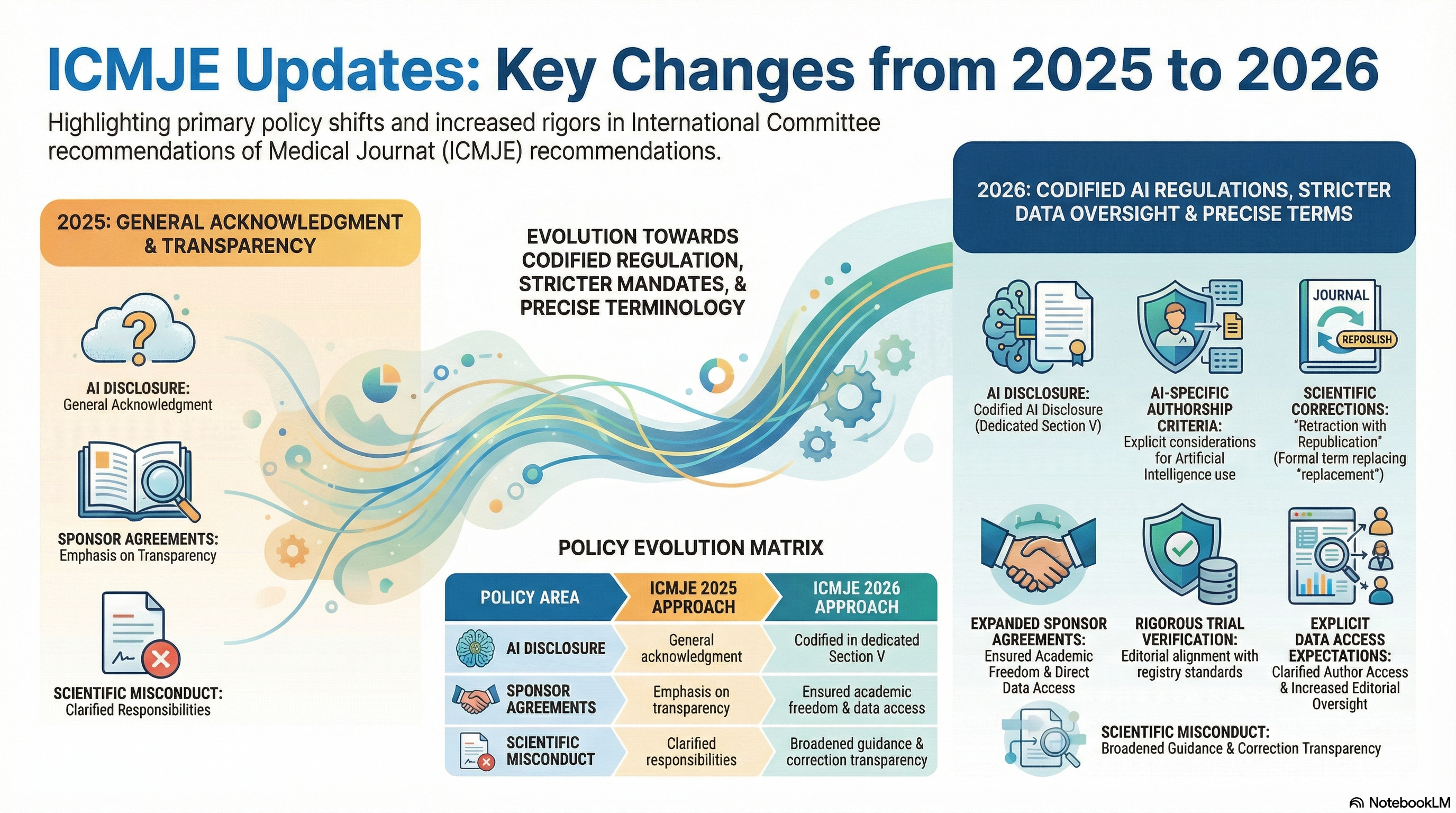
Note: The above image is generated using NotebookLM for illustration and understanding purposes only.
Implications for Medical Communication and Publishing
The 2026 Recommendations mark a significant maturation of governance standards in medical publishing. By formalizing AI oversight, reinforcing author access to primary data, refining correction terminology, and strengthening protections against sponsor influence, ICMJE has moved from principle-based guidance to more operational accountability.
Medical writers must now actively disclose AI use, rigorously verify AI-assisted content, and confirm they have complete access to and responsibility for the study data. Journals and publishers must establish clear AI governance policies, protect manuscript confidentiality, and strengthen editorial scrutiny of data access and funding arrangements.
Collectively, these changes send an unambiguous signal: as AI and complex sponsorship models reshape research workflows, maintaining trust in scientific communication requires proactive transparency, enforceable accountability, and clearly defined human responsibility at every stage of publication.
Author:

Anagha Nair
Editorial Assistant, Enago Academy
Medical Writer, Enago Life Sciences
Connect with Anagha on LinkedIn