

Optimizing Abstracts and Posters: How to write for scientific conferences and virtual platforms
Conferences, both in-person and virtual are crucial for research dissemination, networking, and collaboration. For many scientists, presenting at a conference begins long before the event itself—starting with crafting an impactful abstract and culminating in designing an effective poster. Yet, despite their importance, many researchers struggle to write good abstracts and design posters that accurately reflect their research and engage their audience.
Why Abstracts and Posters Matter
Before diving into best practices, it’s important to understand why abstracts and posters deserve thoughtful attention.
Abstracts Drive Acceptance and Discoverability
An abstract is often the first, and sometimes the only piece of your research seen by reviewers and attendees before the event. It provides essential context and builds interest in your work. A well-written abstract can significantly influence selection committees’ decisions, shaping not just acceptance but also allocation to oral or poster sessions, as well as anticipated audience interest. Conferences use abstracts for peer review and program placement; for example, abstracts may be indexed in databases such as Scopus or PubMed , increasing long-term discoverability.
Posters Facilitate Engagement
Posters serve as a condensed and visual summary of your work. They are designed to spark curiosity, discussion, and collaboration. According to a study, traditional poster sessions at scientific conferences, most posters receive only ~6.4 direct visitors before being discarded, but when digital platforms host posters online, thousands of additional views are possible.
Before exploring how to construct abstracts and posters well, it’s vital to recognize how they are different.
Abstracts vs. Posters: Key differences
Abstracts and posters serve distinct but complementary roles in scientific communication. While both summarize research, they differ in purpose, format, depth, and how audiences engage with them.
Aspect |
Abstract |
Poster |
|
Primary purpose |
To summarize the study and support review, selection, and discoverability |
To visually communicate the study and facilitate discussion |
|
When it is used |
Before the conference (submission, review, indexing) |
During the conference (presentation and interaction) |
|
Length |
Short (usually 150–300 words) |
Larger format with limited text + visuals |
|
Format |
Text-only, structured or unstructured |
Visual layout with figures, charts, and headings |
|
Audience interaction |
Passive (read-only) |
Active (questions, discussion, networking) |
|
Level of detail |
High-level overview |
Selective detail, focused on key findings |
|
Role in acceptance |
Critical—often determines acceptance or rejection |
Secondary—only presented after acceptance |
|
Discoverability |
Often indexed in databases (PubMed, Scopus) |
Increasingly shared via repositories and academic platforms |
|
Longevity |
Long-term (can remain searchable for years) |
Traditionally short-term, now extended via digital platforms |
Think of the relationship like this:
- The abstract is the pitch
It convinces reviewers and readers that your research is worth attention. - The poster is the conversation
It turns that interest into understanding, discussion, and collaboration.
![Abstract vs. poster]() (Disclosure: The above infographic is generated using Notebook LM for illustrative purpose.)
(Disclosure: The above infographic is generated using Notebook LM for illustrative purpose.)
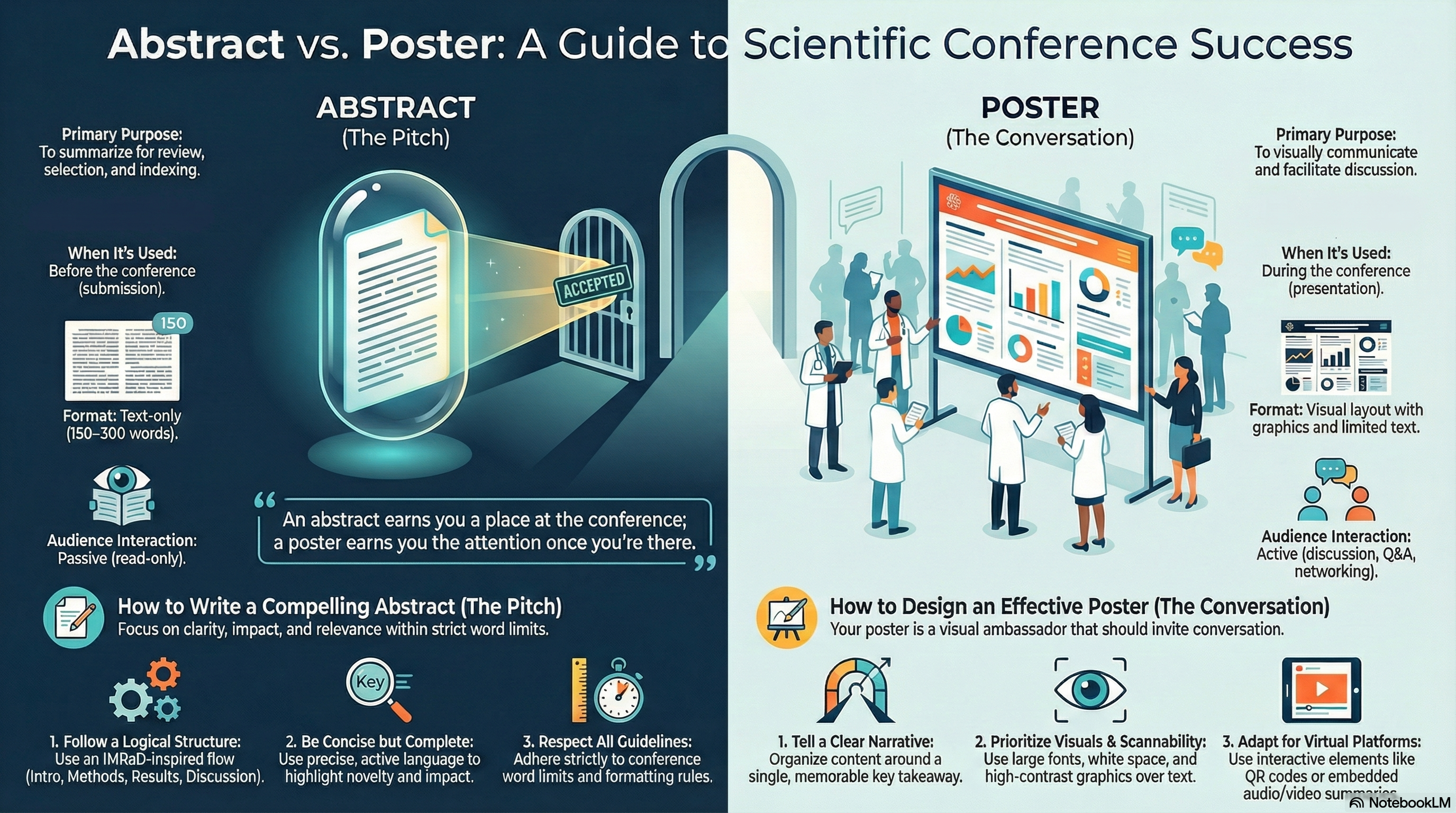
In one sentence, an abstract earns you a place at the conference; a poster earns you the attention once you’re there.
How to Write Compelling Abstracts?
Abstracts are judged on clarity, impact, and relevance, often with strict word limits (typically 150-150 words). To ensure your abstract works effectively:
1. Follow a Logical Structure
Most effective abstracts adopt a clear structure that guides the reader from problem to contribution. A traditional IMRaD-inspired flow—Introduction, Methods, Results, and Discussion–helps reviewers rapidly assess your study’s purpose and significance.
Instead of bombarding your abstract with technical details, focus on answering:
- What is the problem or question?
- Why does this matter?
- What approach did you take?
- What are the key findings and their implications?
Keep these elements tightly written and thematically connected.
2. Be Concise but Complete
Good abstracts are succinct without sacrificing completeness. Avoid jargon where possible and explain specialized terms only when essential. Use precise, active language that highlights novelty and impact. This is especially important when abstracts are viewed as standalone text in digital conference programs.
3. Respect Format and Guidelines
Most conferences provide templates or explicit word limits. Adhering to them shows professionalism and ensures your abstract reaches reviewers without technical issues. Include all required metadata like title, author names, affiliations, as requested.
A disciplined revision process—drafting first, then editing later—helps you trim redundancy and enhance clarity. Focus on information that best represents your contribution.
Designing Interactive Posters
The poster is a visual ambassador for your research. It should quickly communicate the essence of your work and invite conversation. With hybrid and virtual conferences becoming common, poster design must adapt to multiple presentation modes. To facilitate this:
1. Start With a Clear Narrative
Begin by defining the central story your poster will tell. What is the key takeaway you want the viewer to remember? Organize your content so that someone scanning the poster for a minute can understand your research without a verbal explanation.
Break down your poster into standard scientific sections:
- Title and authors
- Introduction and rationale
- Methods
- Results (visualized clearly)
- Conclusions and implications
- References and acknowledgments
2. Visual Hierarchy and Scannability
Effective posters incorporate a visual hierarchy:
- Use large, readable fonts for titles and headings.
- Employ white space to separate sections and reduce clutter.
- Choose high-contrast color schemes to enhance readability.
- Prioritize graphics like charts, figures, and infographics that communicate data more effectively than text.
- Minimize text and use bullets and short phrases. Emphasize visual storytelling so that your audience can comfortably absorb key insights without extensive reading.
Adapting Posters for Virtual Platforms
Virtual poster sessions often challenge researchers to translate traditional posters into interactive digital content.
1. Use Interactive Features Wisely
Unlike printed posters, digital posters can embed interactive elements:
- Hyperlinks or QR codes directing viewers to full papers, datasets, or supplementary content.
- Embedded audio or short video summaries to explain complex concepts.
- Clickable figures or charts that expand for more detail.
These enhancements help bridge the physical distance between presenter and audience.
2. Engage Through Virtual Sessions
Many platforms support live or asynchronous discussions where presenters can schedule short pitch videos, host Q&A sessions, or use chat forums to maintain dialogue around their posters. Being active during scheduled interaction periods significantly improves visibility and networking opportunities.
Preparing a concise “elevator pitch” to accompany your poster can help spark deeper interactions online. Furthermore, use chat or Q&A features to interact post-presentation and provide downloadable PDFs or infographic summaries to elevate posters from static visuals to dynamic learning tools.
Crafting impactful abstracts and memorable posters is no longer just a matter of fulfilling a requirement; it is a strategic exercise in research communication. Whether your conference is in person, hybrid, or fully virtual, clear storytelling, thoughtful design, and audience awareness are keys to maximizing your research’s visibility and impact.
By applying evidence-based practices, researchers and medical practitioners can overcome the limitations of traditional conference formats and truly connect with their scholarly communities across platforms and borders.
Author:

Anagha Nair
Editorial Assistant, Enago Academy
Medical Writer, Enago Life Sciences
Connect with Anagha on LinkedIn