

Why Datavision Matters for Biopharma and MedTech: Streamlining Publication Management
What Is Datavision?
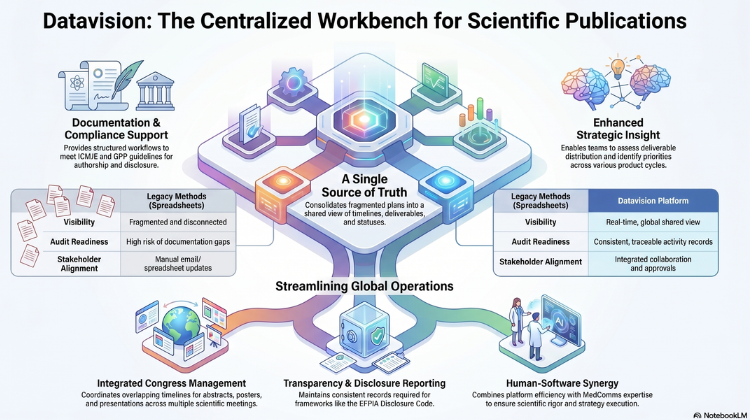
Datavision is a publication management system used in medical communications to support the planning and tracking of scientific publications. It centralizes the planning, execution, and tracking of scientific publications, congress activities, and related workflows into a single system. [1]
The platform provides a structured environment for managing publication activities such as manuscripts, abstracts, and presentations across their development lifecycle. It supports collaboration among stakeholders including medical writers, authors, reviewers, and publication teams involved in publication planning. [1]
By functioning as a centralized workbench, Datavision enables users to organize publication activities and track progress across multiple documents and timelines, supporting coordinated management of complex publication programmes.
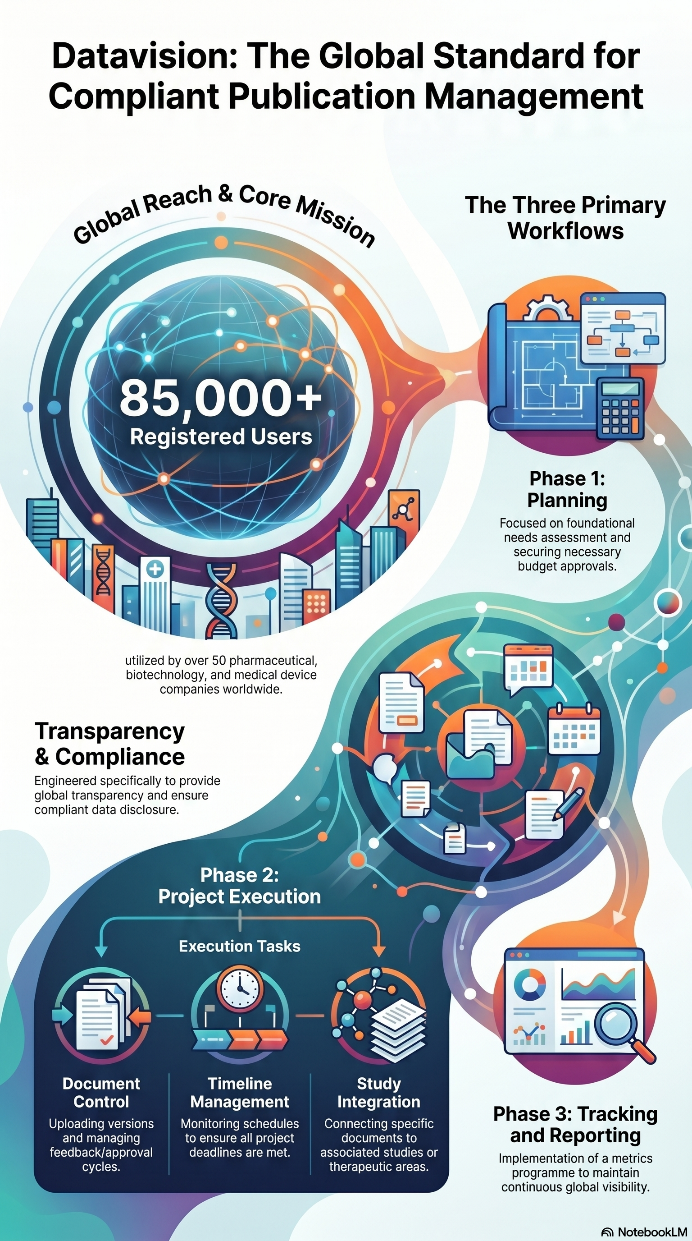
(Disclosure: The above image is generated using Notebook LM for illustrative purposes.)
Why Datavision Matters—Core Value Pillars
1.1 A Single Source of Truth for the Publication Plan
Publication planning often becomes fragmented when different teams manage timelines and deliverables independently across spreadsheets and local trackers, creating challenges not only in consistency but also in audit readiness during internal and external compliance reviews.
Datavision addresses this by consolidating publication plans into a centralized system, allowing stakeholders across global, regional, and affiliate teams to work from a shared view timelines, deliverables, and publication status. [1]
This reduces inconsistencies in tracking and supports alignment across multiple studies, outputs, and contributors. It is particularly relevant in complex publication programmes where coordination across regions and functions is required to maintain consistency and avoid duplication.
1.2 ICMJE, GPP, and Authorship Documentation Support
Publication activities operate leveraging International Committee of Medical Journal Editors (ICMJE) recommendations and Good Publication Practice (GPP) guidelines, which emphasize transparent authorship, contribution tracking, and disclosure of conflicts of interest. [6][7]
Managing these requirements across multiple publications can be complex, particularly in programmes involving numerous contributors and review cycles.
Datavision supports structured documentation of publication workflows, including authorship details, contributions, and approvals workflows. [1]
This enables consistent capture of key information throughout the publication lifecycle and reduces the likelihood of gaps in documentation when managing multiple publication programmes simultaneously.
1.3 Congresses and Scientific Meetings Management
Scientific congresses) play a central role in the dissemination of clinical data.
Presenting at these conferences involve selecting appropriate congresses, managing abstract and poster submissions, coordinating timelines and authors, and aligning outputs with broader communication objectives. [5]
Datavision supports this process through integrated databases of journals and congresses, enabling users to identify relevant publication targets and incorporate them into structured publication plans. [1][3]
This improves visibility across congress-related deliverables and supports coordinated management of timelines across multiple submissions and events, particularly when several congress cycles overlap.
1.4 Transparency and Disclosure Reporting
Transparency frameworks such as the European Federation of Pharmaceutical Industries and Associations (EFPIA) Disclosure Code require organizations to maintain clear records of publication-related activities and associated information. [4]
Managing this information across publication programmes requires consistent documentation of timelines, contributors, and workflows.
Datavision supports structured recording of publication activities within a centralized system, including authorship information and activity tracking. [1]
By consolidating this information, organizations can maintain consistent and traceable records that support internal documentation and reporting processes across publication programmes.
1.5 Strategic Insight, Not Just Operations
Publication planning involves coordinated decisions around what data to publish, when to publish, and where to disseminate findings. [5]
Datavision enables visibility across activities, timelines, and deliverables by organizing publication data within a structured system, [1]
This allows teams to review the status of publication plans, assess how deliverables are distributed across various product cycles s, and identify areas where planning activities is required.
Such visibility supports more informed planning discussions and helps guide future publication priorities within broader evidence-generation efforts.
Datavision in Practice: Illustrative Case Examples
Biopharma Scenario: Late-Stage Oncology Asset
A global biopharma company managing a late-stage oncology asset needed to coordinate publications across ASCO, ESMO, and ASH. The plan included multiple manuscripts, abstracts, and stakeholders across regions [5]
Challenge: Tracking across spreadsheets and emails limits visibility into timelines and dependencies.[5]
Datavision in action: The company centralized its publication plan into a single system. This improved real-time tracking of timelines, authorships, and deliverables. It also helped teams stay aligned across regions.
Outcome: This led to more consistent coordination and improved adherence to planned publication timelines.
MedTech Scenario: Post-Market Evidence Generation
A medical technology company managing a Class III device required ongoing dissemination of post-market clinical evidence across journal articles, conference presentations, investigator-led studies, and registry analyses [5]
Challenge: Disconnected systems made it difficult to track study outputs, manage authorship, and maintain compliance documentation. [5]
Datavision in action: The platform linked post-market studies directly to publication outputs, enabling structured planning and execution. Compliance features ensured consistent tracking of author contributions and disclosures.
Outcome: This enabled more consistent documentation of publication activities and improved traceability of evidence generation over time. This supported improved on-time delivery, more reliable documentation, and strengthened audit readiness.
Where Software Alone Falls Short
While Datavision provides a structured framework for managing publication workflows, it does not replace the expertise required for effective execution.
Publication development involves coordination among authors, reviewers, and medical writers and requires structured project management to ensure consistent delivery. [2]
Although the platform supports documentation and tracking, activities such as manuscript development, scientific interpretation, and strategic planning remain dependent on specialized expertise. [1]
Furthermore, the effectiveness of the system depends on the quality and completeness of the data entered. Without active oversight and well-defined processes, intended outcomes may not be achieved.
For this reason, the most effective approach combines Datavision with experienced MedComms professionals who can translate strategy into execution, ensure scientific rigor, and maintain consistency across global publication deliverables.
Strengthening Adoption: Awareness and Capability Gaps in Executing Datavision
While Datavision is widely used by large pharmaceutical and biotechnology companies, awareness and familiarity are not consistent across the broader medical communications ecosystem. Smaller agencies and independent medical writers may have limited exposure to structured publication management platforms.
There is a need to build capability in effectively using such systems. Technical training and practical experience in integrating platform-based workflows into publication planning can facilitate medical writers to manage timelines, track document versions, coordinate stakeholders, and maintain compliance documentation.
An experienced medical communication partner can help pharma companies with structured execution of Datavision. Enago Life Sciences supports this through medical writing, publication planning, and project management expertise enabling end-to-end execution within structured publication environments.
Contact us at https://lifesciences.enago.com/publications.html to streamline your Datavision workflows and strengthen end-to-end publication planning and execution.
References
- European Medical Writers Association. “Datavision – What Do Medical Writers Need to Know?” EMWA Journal. https://journal.emwa.org/software-for-medical-writers/datavision-what-do-medical-writers-need-to-know/
- European Medical Writers Association. “Project Management in Medical Publication Writing: A Less Explored Avenue in Pharmaceutical Companies and Clinical Research Organisations.” EMWA Journal. https://journal.emwa.org/authors-and-authorship/project-management-in-medical-publication-writing-a-less-explored-avenue-in-pharmaceutical-companies-and-clinical-research-organisations/
- European Medical Writers Association. “Publication Management Software for Medical Writers.” EMWA Journal. https://journal.emwa.org/eu-regulations/publication-management-software-for-medical-writers/
- European Federation of Pharmaceutical Industries and Associations. EFPIA Code Report on Ethics & Compliance Activities. July 2025 https://www.efpia.eu/media/rczepk3q/efpia-code-report-2024.pdf
- Intuition Labs. “Medical Writing & Publication Planning: An Industry Guide.”
https://intuitionlabs.ai/articles/medical-writing-publication-planning - International Committee of Medical Journal Editors. Recommendations for the Conduct, Reporting, Editing, and Publication of Scholarly Work in Medical Journals. 2024. http://www.icmje.org/icmje-recommendations.pdf
- International Society for Medical Publication Professionals. GPP 2022: Good Publication Practice Guidelines for Company-Sponsored Biomedical Research. 2022.
https://www.ismpp.org/gpp-2022